

HFO is usually the better economic candidate for a large plant with a stable base load, high annual operating hours, and dependable access to discounted heavy fuel oil. Diesel is usually the better project choice when demand varies, commissioning speed matters, fuel quality is uncertain, or the site cannot support a full treatment plant.
That verdict depends on one test: can the HFO fuel-price advantage pay for every additional system needed to make HFO reliable and compliant? A low fuel quotation does not answer that question. The comparison must use net electricity delivered over the plant’s life.
HFO vs Diesel at a Glance
The fuel decision changes the balance of plant, operating team, and environmental scope—not just the engine’s fuel line.
| Decision factor | HFO power plant | Diesel power plant |
| Best fit | Stable, high-use base load | Variable or rapidly deployed power |
| Fuel system | Heated storage and full treatment | Simpler conditioning route |
| Project scope | More auxiliaries and interfaces | Smaller balance of plant |
| Operation | More fuel-quality control | Easier routine handling |
| Emissions | Higher fuel-quality sensitivity | Usually easier sulfur compliance |
| Buying metric | Net lifecycle cost per MWh | Net lifecycle cost per MWh |
Treat this table as a screening tool. The final choice requires the same hourly load profile, site conditions, and financial assumptions for both bids.
Continuous Power Is a Duty Rating, Not a Fuel Type
A plant that runs every day is not automatically using a continuous rating. Under ISO 8528-aligned terminology, continuous power serves a substantially constant load for unlimited annual hours. Prime power also permits unlimited hours, but the load varies, and the manufacturer’s permitted average load applies.
This distinction changes equipment sizing. A mine with crushers cycling on and off may need prime-rated units even though the power station operates around the clock. A factory exporting a fixed block of power may fit continuous duty. Asking suppliers to compare “24/7 generators” without the hourly load curve invites incompatible ratings.
Define the operating mode, minimum load, largest load step, reserve margin, and planned maintenance before comparing engine outputs. Fuel selection comes after the duty is clear.
HFO Wins Only When the Annual Fuel Spread Beats the Complexity Premium
A 10 MW plant operating at an 85% load factor for 8,000 hours delivers 68,000 MWh before plant auxiliaries and losses. That arithmetic explains why a modest fuel-cost difference can dominate a high-utilization project’s economics—and why an idle HFO treatment system never pays back.
Calculate each option with this structure:
Lifecycle generation cost = landed fuel + lubricating oil + treatment consumables + auxiliary electricity + maintenance + staffing + emissions compliance + annualized capital cost, divided by net MWh delivered.
Use guaranteed fuel-consumption curves at the expected load points. Then deduct power consumed by separators, heaters, pumps, cooling equipment, and other auxiliaries. Gross generator efficiency can look attractive while the plant exports fewer kilowatt-hours than the financial model assumes.
Run at least three fuel-price cases: expected, narrow spread, and supply disruption. Choose HFO only if it remains competitive outside the most optimistic case.
Diesel Buys Simplicity and Operating Flexibility
Diesel removes several hot-fuel interfaces and shortens the route from delivery tank to engine. That reduces commissioning work, operator workload, and the number of auxiliary components that can interrupt generation. The benefit is strongest at smaller, temporary, or phased sites where HFO infrastructure would be underused.
Do not assume every diesel generator accepts a full block load or every HFO engine responds slowly. Transient response depends on engine design, turbocharging, controls, alternator inertia, spinning reserve, and the size of each load step. A multi-unit HFO plant may follow demand better than one oversized diesel unit because operators can start or stop generating blocks.
Compare the selected diesel generator platform and HFO engine on the same load-step schedule. Require allowable frequency and voltage deviations in the technical offer.
An HFO Plant Is a Fuel-Processing Plant
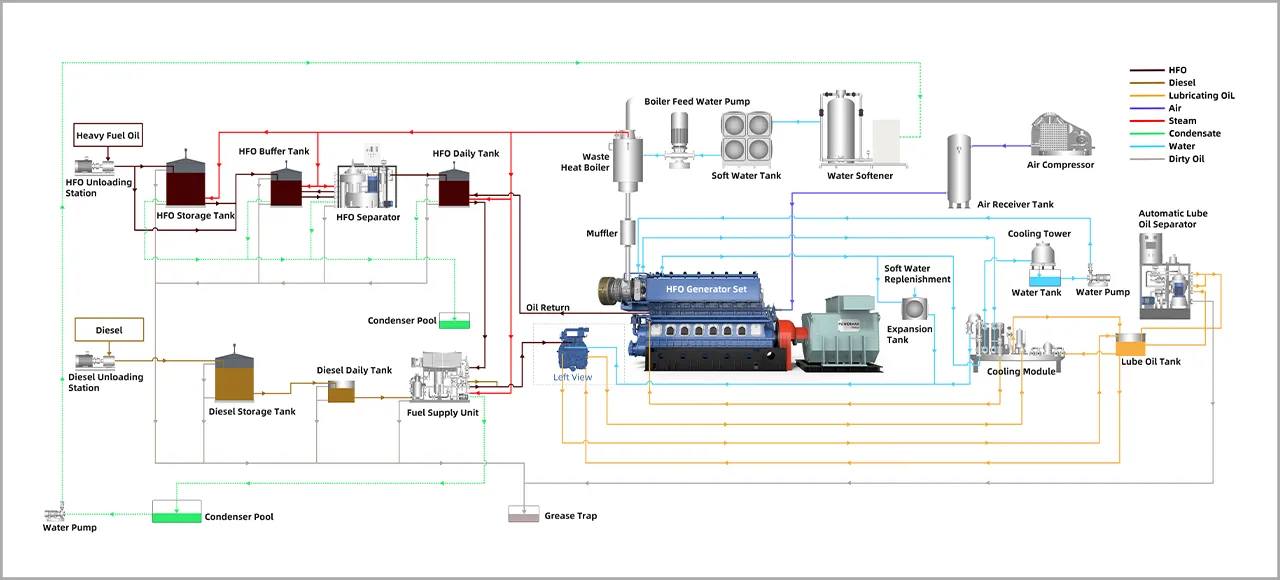
HFO can contain water, sediment, asphaltenes, and hard catalytic particles. It also needs controlled heating so the fuel reaches the viscosity required by the injection system. Storage tanks, transfer pumps, settling or buffer tanks, heaters, separators, service tanks, filters, and booster modules therefore form one operating chain.
The HFO power plant solution illustrates the resulting scope: HFO remains the main operating fuel while diesel supports startup, shutdown, and flushing. The treatment and supply modules are part of the generating system, not optional accessories.
Design out single points of failure. A plant expected to run through separator maintenance needs appropriate standby capacity, clean service-tank autonomy, and a defined diesel operating strategy. Include treatment sludge, oily water, and filter waste in the operating plan.
Fuel Quality Determines HFO Maintenance Cost
Catalytic fines are hard aluminium- and silicon-based particles left by refinery cracking processes. If separators and filters do not remove them, they can abrade fuel pumps, injectors, piston rings, and cylinder liners. Water, incompatible blends, and unstable sediment create different failure paths.
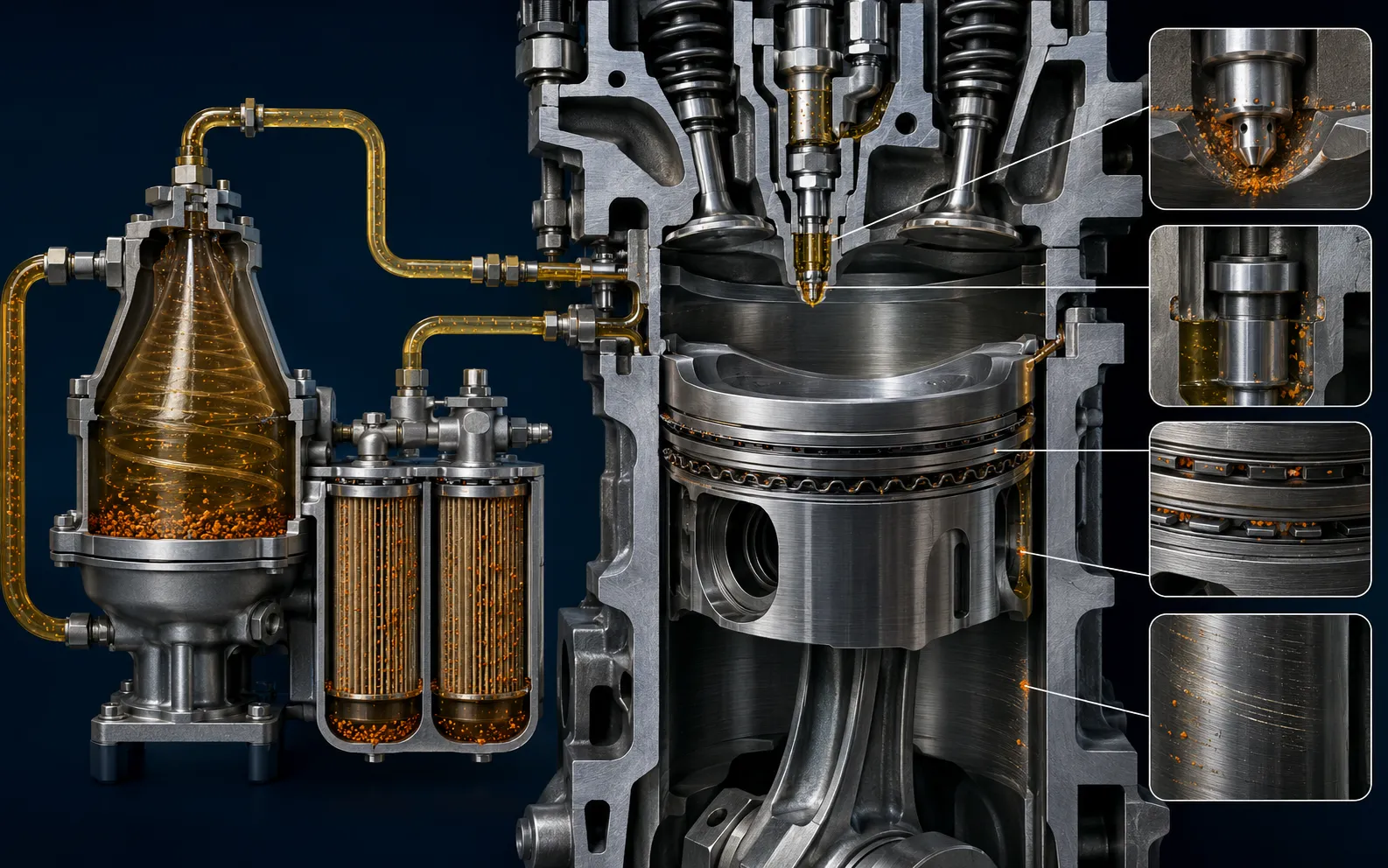
A purchase order that says only “HFO” is incomplete. State the applicable fuel specification, viscosity grade, sulfur limit, density, water, sediment, ash, vanadium, sodium, aluminium plus silicon, and compatibility requirements. Test representative deliveries and define rejection or price-adjustment procedures in the supply contract.
Diesel also needs clean storage, water control, and filtration. Its advantage is a wider tolerance for a lean operating organization—not freedom from fuel management. Keep critical filters, injector components, and treatment spares at the plant, and schedule maintenance around unit redundancy rather than calendar dates alone.
Emissions Permitting Can Reverse the Financial Result
Fuel sulfur largely determines sulfur-oxide emissions, while ash and metallic constituents contribute to particulate matter. Local limits may therefore require lower-sulfur HFO, exhaust treatment, taller stacks, continuous monitoring, or a different fuel altogether. Those changes can erase the original fuel-price spread.
Diesel is not an emissions-free option. Both plants must address nitrogen oxides, particulate matter, noise, liquid waste, and spill containment. The comparison should use the actual fuel certificates and dispersion study, not a generic label such as “clean diesel” or “low-cost HFO.”
Obtain the emissions basis before freezing the engine and stack layout. A cheap fuel that delays the permit is expensive power.
Which Plant Should You Choose?
Choose HFO When
Choose HFO when the project has all of these conditions:
- A large, predictable load that keeps several units productively loaded
- High annual operating hours over a long project life
- A durable delivered-price advantage backed by more than one supply route
- Fuel quality that the proposed treatment system can consistently manage
- Skilled operators, laboratory support, and planned treatment redundancy
- A feasible emissions-control and waste-management plan
Choose Diesel When
Choose diesel when one or more of these conditions dominate:
- Demand is uncertain, seasonal, or changes sharply during each shift
- Capacity will be added in phases or moved to another site
- Fast delivery and a compact balance of plant carry financial value
- HFO supply, quality, or storage infrastructure is unreliable
- Local emissions limits make residual fuel difficult to permit
- The owner needs simpler staffing and maintenance logistics
A mixed arrangement can reduce the risk. Multiple generating units can match the load, while diesel provides startup, shutdown, flushing, or emergency operation for an HFO plant. Specify the changeover procedure and diesel autonomy instead of assuming the backup route will work when needed.
Make Bidders Prove the Better Option
Issue one data package to every bidder: the load curve, ambient conditions, fuel analyses and delivered prices, operating-hours target, emissions limits, reserve, electrical interface, and maintenance philosophy. Request guaranteed net output, fuel consumption at several loads, auxiliary demand, scheduled outages, consumables, and overhaul scope.
HFO is better only when the site can operate the whole fuel-to-electricity chain and the savings survive conservative assumptions. Diesel is better when simplicity protects availability or preserves flexibility. The winning proposal is not the one with the cheapest tonne of fuel; it is the one with the lowest credible cost for every megawatt-hour the facility can actually use.