

Multiply dependable biogas flow in Nm³/h by the methane fraction, 9.936 kWh/Nm³, and the engine’s guaranteed electrical efficiency. A flow of 500 Nm³/h at 58% CH₄ and 38% efficiency supports about 1,095 kW gross.
That figure is a fuel ceiling, not an automatic nameplate selection. The final generator set must also fit the site rating, hourly electrical load, permitted export, auxiliary demand, minimum engine load, and any gas-storage strategy. Adding a blanket safety margin to the theoretical kW hides which constraint is actually short.
Put every gas input on the same basis
One cubic metre is not a fixed amount of gas until its temperature, pressure, and water basis are stated. A flow meter may report actual m³/h, normalized Nm³/h, standard m³/h, or a mass-flow value converted to volume by its own reference settings.
Normalize the volume
For the formula used here, Nm³ means dry gas at 0 °C and 1 atm. That matches the basis for the methane heating value used below. Other contracts and standards may use 15 °C or another base temperature, so the label alone is not enough.
Ask the meter vendor to state the reference temperature, absolute pressure, and wet-or-dry basis. Apply the same basis to the laboratory LHV and the engine fuel-consumption data; otherwise, the arithmetic can be tidy and still be wrong.
Pair flow with methane content
A monthly average flow and a methane test from a different hour do not describe one fuel stream. Build a time series in which flow and CH₄ percentage share the same timestamp, then agree on the low but normal operating case that the plant expects the generator to carry.
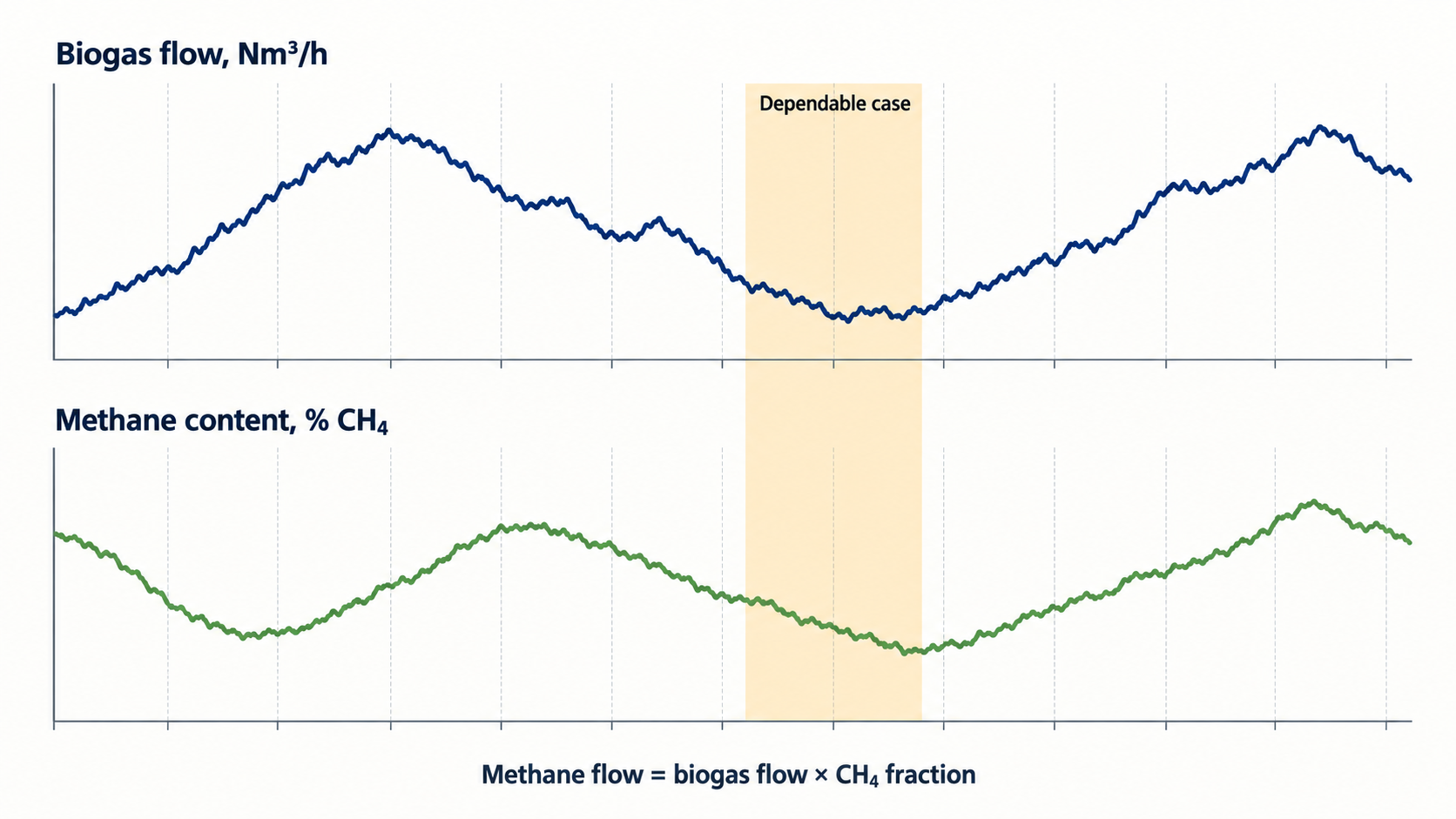
For an existing digester, use representative operating history across feedstock and seasonal changes. For a new plant, keep the BMP or process-model estimate as a forecast until pilot data or a performance guarantee supports it.
Gas quality requirements still determine whether the engine can hold the calculated output. Hydrogen sulfide, moisture, and siloxanes do not add useful energy to the shortcut, but they can restrict operation or damage equipment. Freeze the reference conditions and the simultaneous low-case dataset before converting gas flow to kW.
Calculate the fuel-limited gross output
At 0 °C and 1 atm, methane has a lower heating value of 35.770 MJ/Nm³, equal to 9.936 kWh/Nm³. The preliminary equation is:
P_fuel,gross = Q_N × x_CH₄ × 9.936 × η_e
Where:
- Q_N is dependable dry biogas flow in Nm³/h.
- x_CH₄ is methane volume fraction as a decimal.
- η_e is OEM-guaranteed electrical efficiency on this gas and duty, as a decimal.
- P_fuel,gross is the gross electrical power supported by the fuel, in kW.
If the gas analysis provides total LHV, use Q_N × LHV_biogas × η_e instead. The methane shortcut assumes other combustible constituents are negligible; a full LHV captures gases such as hydrogen or carbon monoxide when they are present.
Worked example
Assume the dependable case is 500 Nm³/h at 58% CH₄. Use 38% electrical efficiency only as a planning assumption until an engine supplier guarantees a value for the specified gas.
| Calculation | Result |
| Biogas LHV: 0.58 × 9.936 | 5.763 kWh/Nm³ |
| Fuel input: 500 × 5.763 | 2,881.5 kW |
| Gross output: 2,881.5 × 0.38 | 1,095.0 kW |
Do not substitute CHP total efficiency for η_e; recovered heat does not pass through the generator terminals. Carry 1,095 kW gross forward as the fuel limit, then test actual machine options against it.
Separate the three kW limits
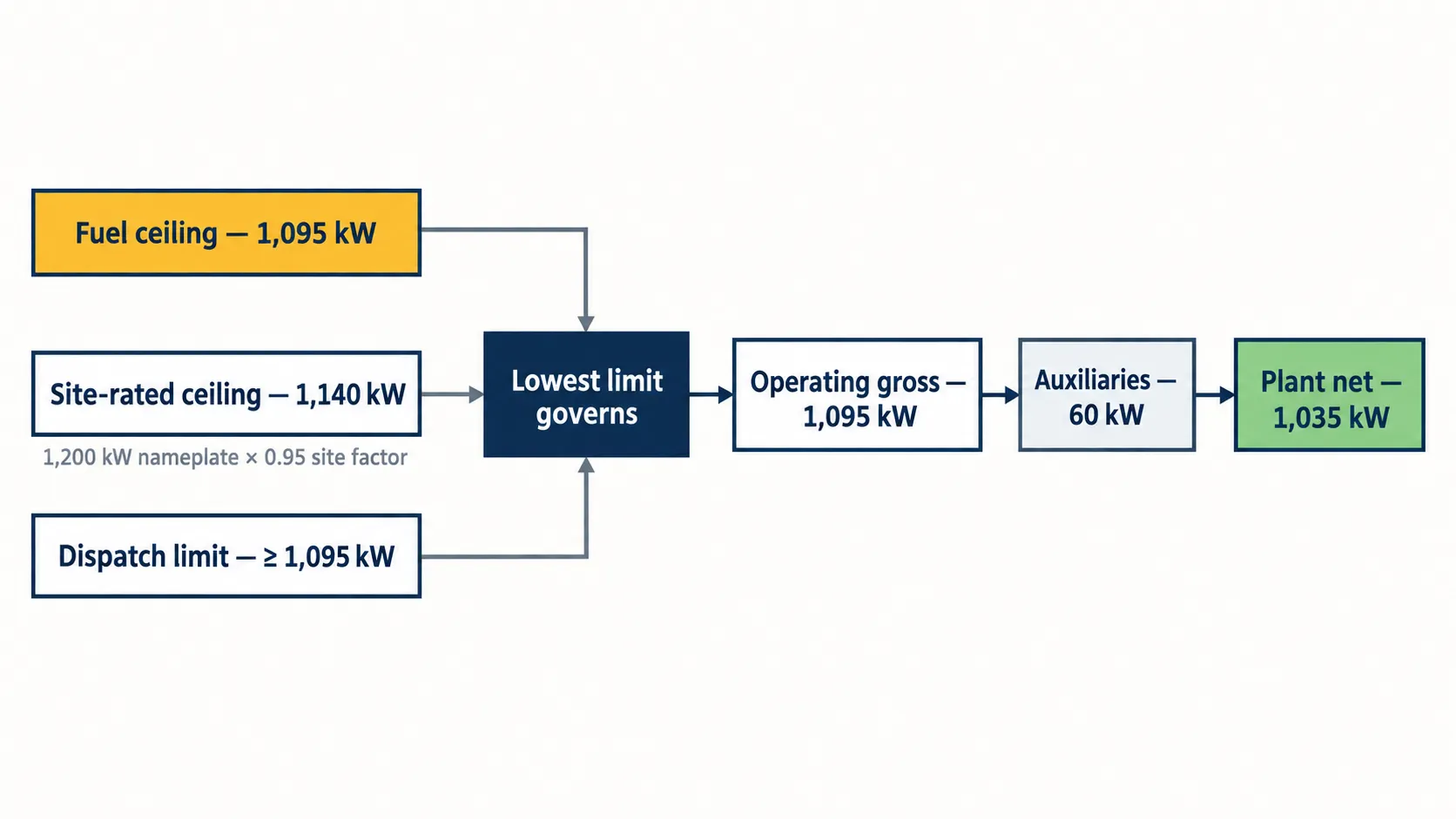
Three values can cap gross output: methane energy, site-rated machine capacity, and the electrical dispatch limit. Keep them visible in one equation:
Find the binding gross limit
P_operating,gross = min(P_fuel,gross, P_site,rated, P_dispatch)
Suppose a candidate set has a 1,200 kW standard-condition nameplate and the supplier gives a 0.95 site-output factor for the project’s altitude, ambient temperature, and cooling system. Its site-rated ceiling is 1,140 kW. The fuel can support 1,095 kW, so fuel remains the binding limit.
Subtract auxiliaries once
Now subtract electrical auxiliaries on the chosen boundary:
P_net = P_operating,gross − P_aux
With 60 kW of operating auxiliaries, the example yields about 1,035 kW net. Define whether P_aux includes only generator-package equipment or the digester, gas treatment, pumps, radiators, transformers, and plant services as well.
If the site can consume or export only 900 kW gross, dispatch becomes the binding limit and surplus gas needs storage, another use, or a flare. Availability belongs in the annual-energy model—average kW × operating hours—not as a second instantaneous derating factor. The proposal must state each limit separately, and the calculation must never apply a site correction twice.
Choose the unit count from the hourly profile
A representative lean-burn spark-ignition engine can lose roughly 8–10% of its full-load efficiency at 50% load. One oversized unit may therefore burn more gas per kWh and spend more time below its preferred operating range.
Match the operating pattern
- Choose one unit when dependable fuel and electrical demand remain close to a stable base load and planned maintenance can be covered by the grid, another source, or controlled flaring.
- Choose multiple smaller units when gas flow or site load changes enough to shut down one set while the others stay in an efficient range. Check whether the smallest online combination can follow the lowest normal methane flow.
- Consider a larger, shorter-run unit when a calculated gasholder balance can accumulate fuel and dispatch generation into selected hours. Storage—not spare nameplate—creates that operating freedom.
Plan the outage case
N+1 redundancy protects availability but does not create methane. If continuous gas disposal is mandatory during an engine outage, the design still needs storage, a flare, a standby gas user, or enough online generation capacity to accept the fuel. Select the unit combination from an hourly gas-and-load simulation, not the average of either curve.
Convert the estimate into a supplier guarantee
An RFQ that says only “500 Nm³/h, 60% methane, 1 MW required” leaves the decisive conditions open. Send enough data for every bidder to calculate the same boundary:
Describe the fuel and duty
- Flow time series with simultaneous minimum, normal, and maximum values, plus meter reference temperature, absolute pressure, and moisture basis.
- Gas composition and variability, including CH₄, CO₂, O₂, N₂, H₂S, moisture or dew point, siloxanes where relevant, and laboratory LHV.
- Gas pressure and temperature at the engine gas-train inlet after dryers, filters, blowers, and treatment-system pressure losses.
- Operating mode, voltage, frequency, grid or island duty, load steps, motor starts, permitted export, and the hourly site-load profile.
- Site elevation, ambient-temperature range, cooling-medium temperatures, enclosure conditions, and emission limits.
- Auxiliary-load schedule and a one-line definition of gross, package-net, and plant-net output.
- Requested guarantees for site-rated kW, fuel consumption or heat rate at several loads, minimum continuous load, gas-quality limits, and response to off-spec fuel.
Request auditable guarantees
Powermax Energy can configure a biogas-to-power system against this dataset, including gas conditioning, generator sets, controls, and plant interfaces within the agreed scope. Require the final proposal to return both the guaranteed fuel curve and the calculation sheet; a model number alone is not a sizing answer.
Let the weakest normal case set the purchase order
Use the lowest agreed normal methane-energy case for continuous output, then let storage and dispatch calculations justify any capacity above it. This prevents a larger nameplate from disguising a weak fuel forecast and prevents an undersized package from wasting gas that the plant can reliably supply.
Keep the sizing sheet for commissioning. Once the plant is running, record normalized flow, CH₄, gross kW, auxiliary kW, ambient conditions, and operating load at the same timestamps. The purchase calculation then becomes an acceptance test: it can show whether a shortfall starts in the digester, gas-treatment train, engine, generator, or plant boundary before the teams argue over one unexplained kW number.