

Biomass Power Plants: Working Principles, Technologies, Costs and Manufacturer Selection Guide
The global energy transition is driving widespread adoption of renewable energy solutions that balance environmental sustainability and grid operational stability. Unlike intermittent renewable sources such as wind and solar power, biomass power stations deliver consistent, reliable baseload power. By repurposing organic waste into usable electricity and thermal energy, modern biomass power plants effectively reduce global dependence on fossil fuels and accelerate the shift to a low-carbon energy future.
The global energy transition is driving widespread adoption of renewable energy solutions that balance environmental sustainability and grid operational stability. Unlike intermittent renewable sources such as wind and solar power, biomass power stations deliver consistent, reliable baseload power. By repurposing organic waste into usable electricity and thermal energy, modern biomass power plants effectively reduce global dependence on fossil fuels and accelerate the shift to a low-carbon energy future.
What Are Biomass Power Plants?
A biomass power plant is a renewable energy facility that converts organic raw materials into electricity and heat. Its core fuel source — biomass — refers to recently grown or renewable organic matter, distinguishing it from finite geological fossil fuels such as coal and crude oil. The sustainability of biomass power generation stems from a natural closed-loop carbon cycle. Plants absorb carbon dioxide (CO₂) from the atmosphere via photosynthesis during growth. When biomass is processed and combusted for power generation, the CO₂ released is nearly equivalent to the amount previously sequestered by the organic matter. With sustainable resource management, biomass power generation achieves an overall carbon-neutral footprint.
Common biomass feedstocks fall into three major categories:
Agricultural Residues: Rice husks, sugarcane bagasse, corn stover, crop straw and other farm waste.
Wood & Forestry Waste: Wood chips, sawdust, tree bark, logging residues and forest thinnings
Organic Solid Waste: Livestock manure, sewage sludge and biodegradable municipal solid waste.
How Do Biomass Power Plants Work?
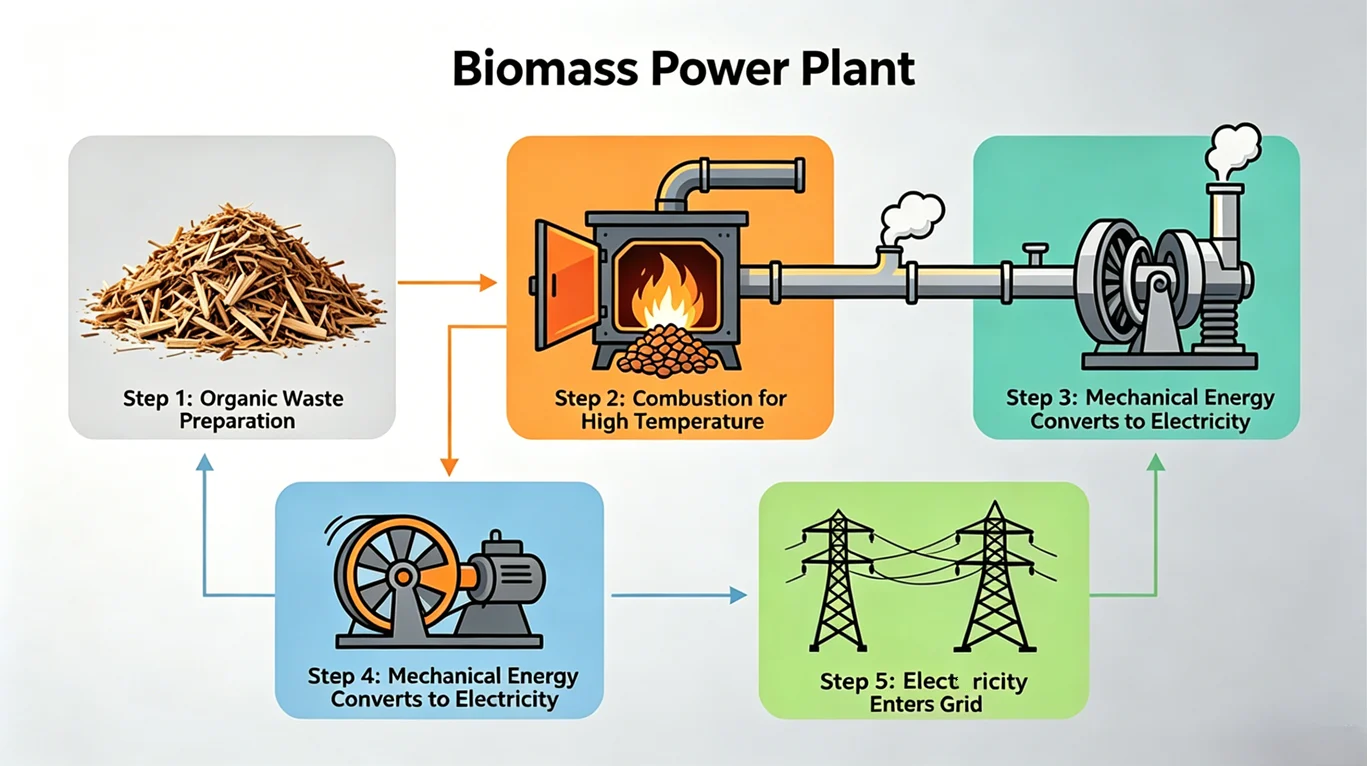
The conversion of raw organic biomass into grid-compliant electricity relies on a coordinated thermal and mechanical workflow. Although multiple technical configurations exist, most commercial-scale biomass power plants adopt direct combustion technology for power generation. The complete operational process is outlined below:
1. Fuel Preparation and Handling
Raw biomass typically features high moisture content, irregular sizes and inconsistent quality. Before entering the power generation system, raw materials undergo standardized processing including storage, drying, crushing and pelletization. This pretreatment ensures uniform fuel quality, stable combustion efficiency and reduced operational risks.
2. Boiler Combustion
The processed biomass fuel is delivered to the specialized furnace boiler. Controlled combustion releases intensive thermal energy, serving as the fundamental energy source for the entire power generation cycle.
3. High-Pressure Steam Generation
The heat generated from combustion heats water circulating through high-strength steel tube networks inside the boiler, converting ordinary water into high-temperature, superheated high-pressure steam.
4. Turbine and Power Generation
High-pressure steam impacts and rotates the blades of a steam turbine. The rotating turbine shaft drives the connected generator, which converts mechanical rotational energy into electrical energy — the final power output delivered to the power grid.
5. Steam Condensation and Water Recycling
After passing through the turbine, low-pressure waste steam flows into a condenser for cooling and liquefaction. The recycled water is pumped back to the boiler for repeated circulation, minimizing water consumption and improving resource utilization efficiency.
Biomass Power Plant Technologies and Cost Analysis
Capital expenditure (CAPEX), operational efficiency and applicable scenarios vary greatly across different biomass conversion technologies. The selection of technical solutions depends primarily on local feedstock types, fuel characteristics and project power output requirements. The following table summarizes the four mainstream biomass power generation technologies, their core features, scalability and average installation costs:
| Technology Type | Key Characteristics | Scalability | Average CAPEX (USD/kW) |
| Direct Combustion (Stoker Boiler) | Mature, reliable and cost-effective technology; compatible with diverse solid biomass fuels with varying sizes and properties | Medium to Large (10–100+ MW) | $3,000 – $4,500 |
| Fluidized Bed Combustion (FBC) | Fuel suspended in a high-temperature sand bed; delivers high combustion efficiency and low flue gas emissions | Large (20–150+ MW) | $4,000 – $6,000 |
| Biomass Gasification | Converts solid biomass into clean synthetic gas (syngas) through oxygen-controlled pyrolysis and gasification | Small to Medium (1–30 MW) | $5,500 – $8,000 |
| Anaerobic Digestion (Biogas) | Microbially decomposes wet organic waste to produce methane-rich biogas; ideal for high-moisture feedstocks | Small to Medium (0.5–10 MW) | $4,500 – $7,000 |