

Wood chips, sawdust, bark, crop residues, rice husks, straw, bagasse, energy crops, manure, food-processing waste, sewage sludge, biogas, landfill gas, and biomass-derived producer gas can all support power generation. They cannot all enter the same machine.
Dry, uniform solids usually suit combustion or gasification. Wet, biodegradable materials usually make more sense in an anaerobic digester, where they produce biogas. A fuel becomes practical only when its moisture, ash, contaminants, physical form, and year-round supply match the conversion system.
A long fuel list still cannot select the conversion route.
Which biomass fuels can generate electricity?
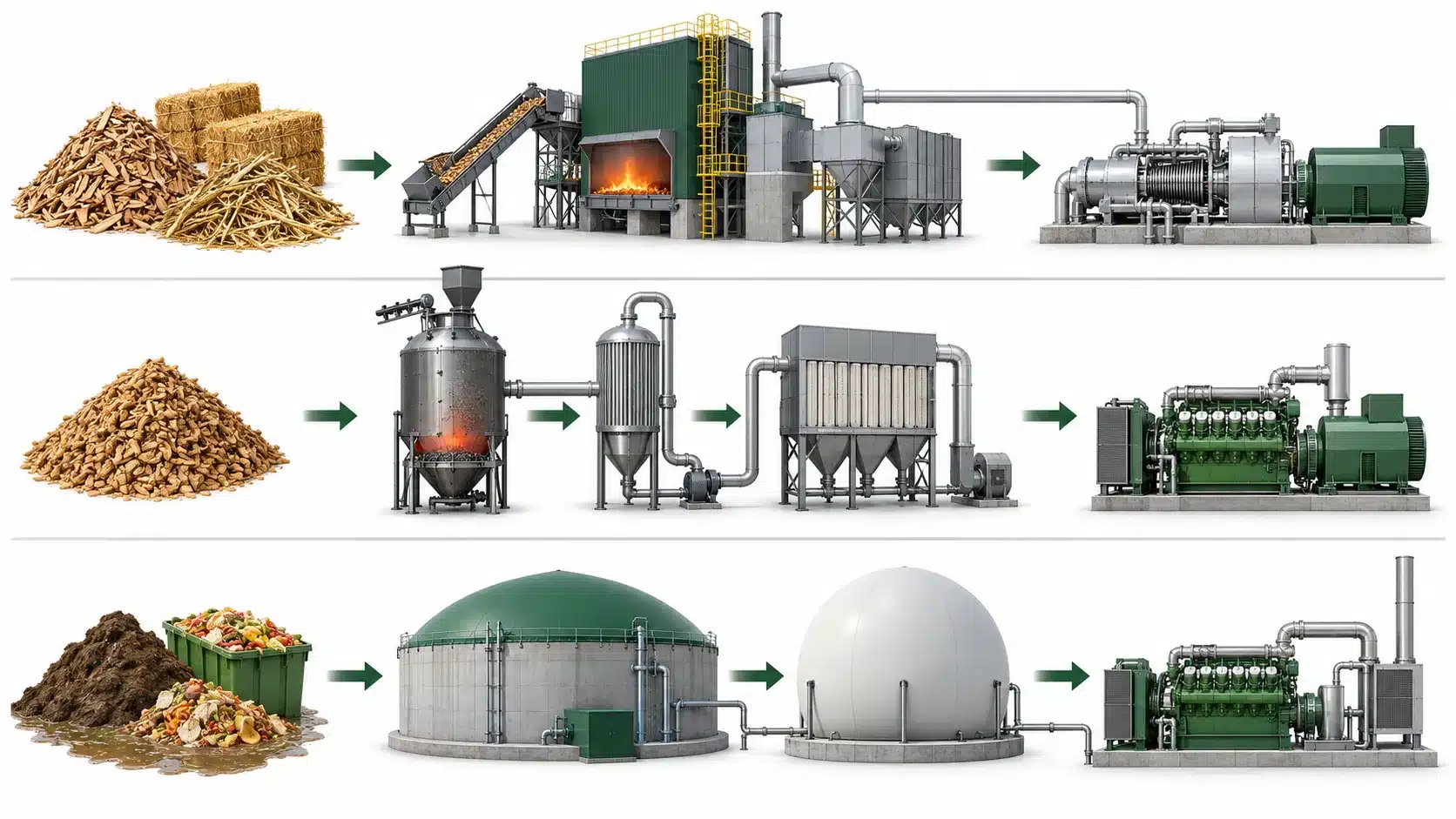
Seven fuel families cover most commercial biomass power projects. The table shows the usual starting route, not a universal acceptance guarantee.
Fuel families and conversion routes
| Fuel family | Common examples | Typical route to electricity | Main screening issue |
| Woody biomass | Wood chips, sawdust, bark, forest residues, pellets | Combustion or gasification | Moisture, chip size, dirt, bark and ash |
| Agricultural residues | Rice husk, straw, corn stover, bagasse, coconut shell, palm residues | Combustion or gasification | Ash chemistry, moisture, seasonal supply and handling |
| Dedicated energy crops | Miscanthus, switchgrass, willow, poplar, bamboo | Combustion or gasification | Delivered cost, land use, ash and storage |
| Wet organic waste | Manure slurry, food waste, sewage sludge, brewery waste | Anaerobic digestion followed by a gas engine or CHP unit | Biogas yield, contaminants and digestate management |
| Biogenic waste fractions | Clean waste wood, paper/cardboard residues, sorted organic municipal waste | Combustion, gasification or digestion, depending on composition | Sorting, metals, glass, plastics and permitting |
| Biomass-derived gases | Biogas, landfill gas and producer gas from gasification | Gas engine, turbine, boiler or CHP system | Heating value, moisture, sulfur, siloxanes, tar and particles |
| Processed biomass fuels | Pellets, briquettes, pyrolysis oil and biodiesel | Boiler, gasification or compatible liquid-fuel engine | Specification consistency and equipment approval |
The first screening decision
This route map adds the missing layer to a basic explanation of how a biomass power plant works. Start with the material’s condition at the site gate, not its biological name.
Woody biomass is usually the easiest solid fuel to qualify
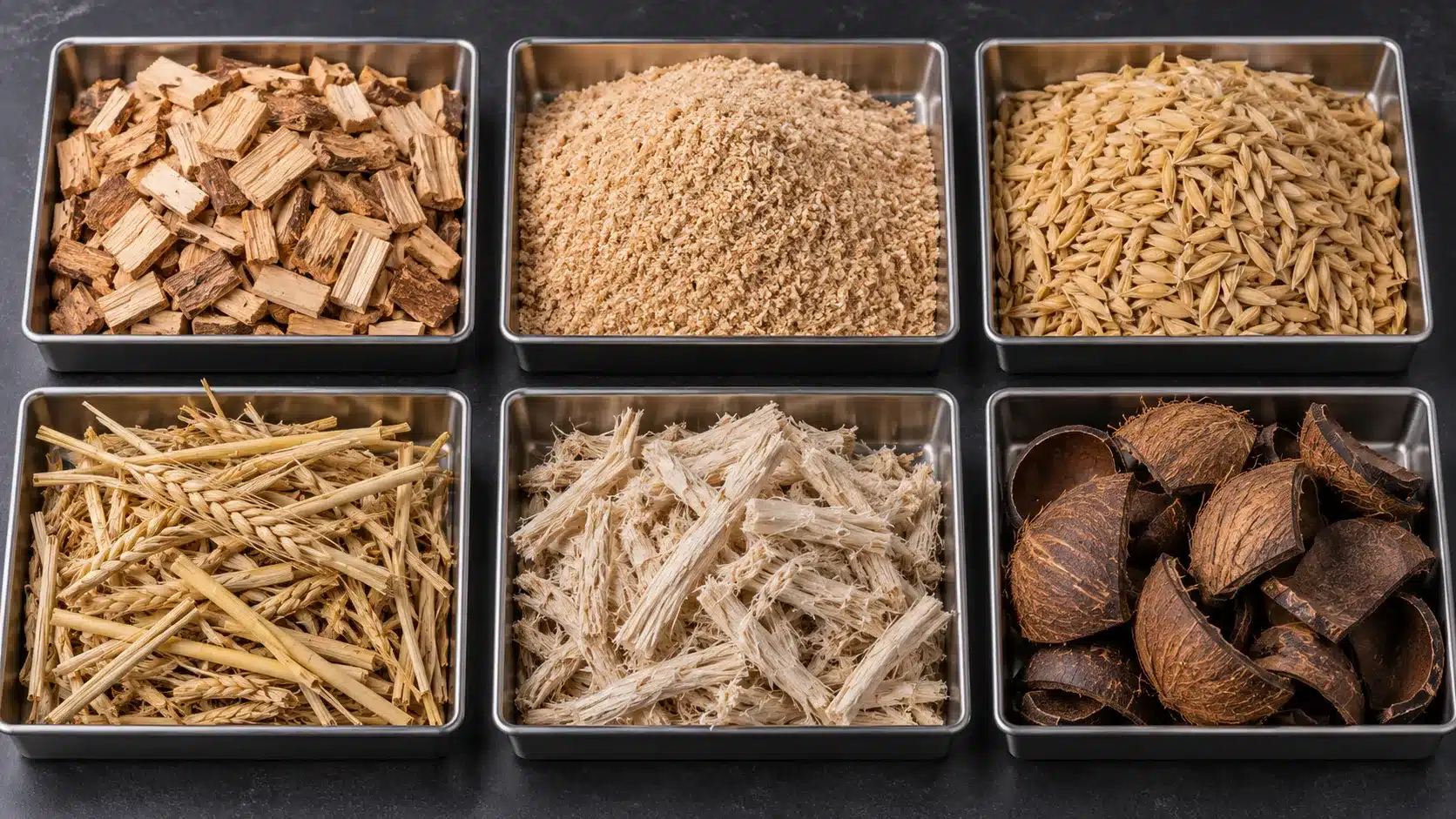
Clean wood chips, sawdust, bark, forestry residues, and pellets have a broad commercial track record. Their fibrous composition and generally manageable ash suit many boilers and gasifiers.
“Wood” is still not a specification. Fresh chips may carry enough water to cut net energy output and increase drying demand. Oversized pieces bridge in hoppers; fines create dust and unstable feeding; soil collected with forest residues raises ash and wear. Treated, painted, or demolition wood can introduce metals, chlorine, and permitting problems.
Pellets and briquettes trade processing cost for higher bulk density and more consistent feeding. I prefer them when transport distance or a small automated fuel system makes uniformity worth paying for. A sawmill with steady clean chips may reach the opposite decision because its residue is already collected on-site.
Ask for separate samples from the wet and dry seasons before treating a woody feedstock as qualified fuel.
Agricultural residues can work, but they are not interchangeable
Rice husk, rice and wheat straw, corn stover, bagasse, coconut shell, and palm-processing residues all generate electricity in commercial projects. The trap is assuming that one successful agricultural fuel validates the others.
Rice husk can carry a mineral load dominated by silica. Straw often brings more potassium and chlorine than clean wood. Bagasse leaves a sugar mill wet but concentrated at one location, which can make on-site steam and power more practical than hauling it elsewhere. Shells may handle and gasify well, while fibrous stalks need cutting, baling, or densification for reliable feeding.
Ash percentage alone does not settle the question. Ash composition and melting behavior determine whether deposits stay manageable or become slag, fouling, corrosion, and shutdowns. The reactor, grate, bed material, temperature, and cleanup system must be selected for the actual residue.
Use a representative laboratory analysis and a bulk handling trial before approving an agricultural fuel.
Wet organic wastes should usually become biogas first
Manure, sewage sludge, food waste, fats and oils, and many beverage or food-processing wastes already contain the water that a combustion plant would have to evaporate. Anaerobic digestion uses that wet condition instead of fighting it.
The digester converts biodegradable matter into methane-rich biogas, which can fuel an engine for electricity and useful heat. Co-digestion can combine compatible materials, but it needs biological testing, contaminant control, and a plan for the remaining digestate. Woody material is a poor default digester feed because lignin resists normal anaerobic breakdown.
Biogas itself needs a fuel specification. Methane concentration and pressure affect usable engine output, while hydrogen sulfide, water, and siloxanes can drive corrosion, deposits, and maintenance. Landfill gas adds another variable: recoverable flow changes over the life of the site.
Treat wet waste as a gas-production project first and a generator project second.
Gasification creates a new fuel with new limits
Wood and qualified crop residues do not enter a gas engine directly. A gasifier converts them into producer gas, then cooling and cleaning equipment must remove enough tar, particles, condensate, and other contaminants for the selected engine.
That system boundary is easy to underestimate. A stable gasifier can still deliver gas that damages valves, turbochargers, or heat exchangers if cleanup falls short. The acceptable gas composition and contaminant limits belong to the engine specification, not to a generic claim that the plant is “biomass compatible.”
Powermax Energy’s biomass gasification power system combines feedstock preparation, gasification, gas cleaning, and generator-set integration. The configuration still depends on representative fuel data, expected quantity, load demand, and site conditions.
Draw the boundary around the complete fuel-to-power train before comparing equipment quotations.
What makes a biomass fuel usable?
A useful pre-RFQ fuel sheet contains measured values and a supply plan. A photograph and the words “rice husk” or “wood waste” are not enough.
Supply data
- Quantity and seasonality: Record monthly recoverable tonnage, competing uses, supplier concentration, and the worst supply month. Annual totals can hide a four-month shortage.
- Logistics and storage: Define delivery method, stock-cover needs, fire and dust controls, drainage, degradation risk, and the sampling procedure for incoming loads.
Fuel properties
- Moisture and heating value: Report moisture on a stated basis and provide higher or lower heating value as required. Water consumes transport capacity and process energy.
- Physical form: Measure particle-size distribution, bulk density, fines, fibers, and oversized pieces. These values shape conveyors, screens, dryers, silos, and feeders.
- Proximate and ultimate analysis: Include ash, volatile matter, fixed carbon, carbon, hydrogen, oxygen, nitrogen, and sulfur. The results guide conversion and emissions design.
- Ash and contaminants: Test ash composition and fusion behavior, plus soil, stones, metals, chlorine, alkali species, and chemical treatment residues where relevant.
These data also expose biomass project cost drivers that a low price per wet tonne conceals. Compare delivered energy and dependable net output, not the cheapest pile at the gate.
Can one plant use several biomass fuels?
A multi-fuel plant can accept several qualified fuels, but only inside a defined fuel envelope. That envelope sets ranges for moisture, particle size, heating value, ash, ash chemistry, and contaminants.
Blending can smooth seasonal shortages or dilute a difficult residue. It can also combine the worst properties of both fuels: wet material lowers reactor temperature while high-alkali ash raises deposit risk. A blend ratio that works in a short test may fail when supplier quality shifts.
Before promising fuel flexibility, test the base fuel, each substitute, and the proposed blends. Then connect the fuel contract to the same acceptance limits used by the plant controls and operating procedures.
Choose the fuel before choosing the plant
The best biomass fuel is rarely the most impressive sample in a laboratory. It is the material that arrives every month, stays within an enforceable specification, and fits a conversion route the operating team can maintain.
Begin with a 12-month supply map and representative fuel analyses. Reject contaminated streams early, compare the remaining options on delivered usable energy, and issue equipment inquiries with a defined fuel envelope. Only then should generator rating, gasifier type, boiler design, storage volume, and emissions controls enter the shortlist. A project built around verified feedstock can adapt; one built around an optimistic fuel name usually spends its contingency on preprocessing.